Crisis Communications Plan: How to Prepare for Reputation Risks Before They Hit
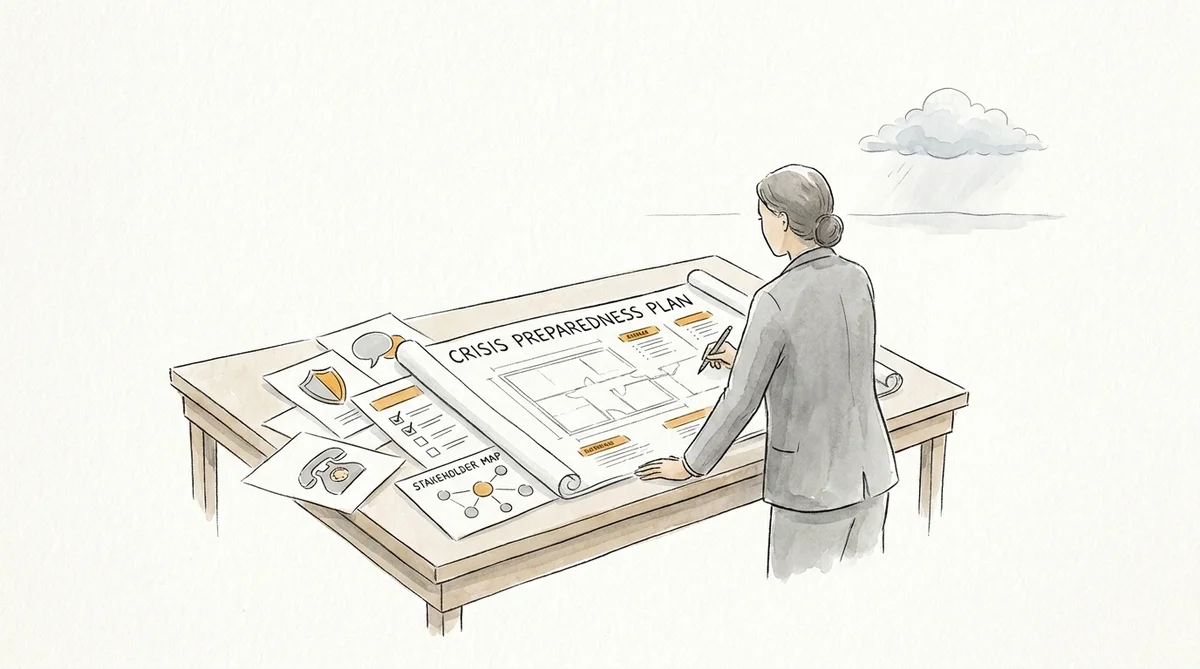
Every organisation will face a reputational threat at some point. A data breach, a product failure, an executive misstep, a social media storm that escalates faster than anyone expected. The difference between those who weather these moments and those who suffer lasting damage almost always comes down to preparation. A crisis communications plan is not something you write during the crisis. It is the strategic groundwork you complete long before one arrives.
Yet preparedness remains patchy. According to the PRCA UK PR Census 2025, only 25% of communications professionals feel their organisation is fully equipped to handle significant industry changes. That figure should concern any leadership team relying on its comms function to protect reputation under pressure. This guide is designed to help in-house teams build a workable plan and to give decision-makers evaluating external PR support a clear picture of what good crisis preparation looks like.
Why Every Organisation Needs a Crisis Communications Plan
The media landscape has changed fundamentally. A decade ago, organisations might have had hours to gather facts and craft a response. Today, social media compresses that window to minutes. A single tweet, a leaked internal email or a viral video can set the narrative before your team has even convened a call.
This is why crisis and issues management has become a defined specialism for roughly 39% of UK comms professionals, and why strategy and planning (59%) now rivals traditional media relations (62%) as a core competency across the sector. Reactive firefighting is no longer enough. Organisations need structured, rehearsed plans that let them respond with speed, accuracy and authority.
A well-built crisis communications plan does three things. It reduces response time by removing ad hoc decision-making under pressure. It protects consistency across spokespeople and channels. And it preserves trust by showing stakeholders the organisation is in control, even when the situation is not.
Start with Risk Mapping
The foundation of any crisis plan is an honest assessment of what could go wrong. Risk mapping means identifying potential threats, assessing their likelihood and impact, and prioritising them so your planning effort goes where it matters most.
A heatmap works well here: a simple grid with likelihood on one axis and reputational impact on the other. Plot every realistic scenario your organisation could face, from operational failures and regulatory investigations to personnel issues, supply chain disruptions and cyber incidents. Then map each risk against the stakeholders it would affect most directly: customers, employees, investors, regulators, media, the general public.
This exercise is not about predicting the future with precision. It is about ensuring your team has thought through the most probable and most damaging scenarios in advance, so that when something does happen, it does not feel entirely unfamiliar.
Common Risk Categories
- Operational: Product recalls, service outages, health and safety incidents
- Digital: Data breaches, cyber attacks, social media crises
- Legal and regulatory: Investigations, compliance failures, litigation
- Personnel: Executive misconduct, redundancies, workplace culture issues
- External: Supply chain failures, political or economic shifts, activist campaigns
For a broader look at how reputational threats escalate when handled poorly, our analysis of high-profile PR disasters offers some instructive examples.
Define Response Roles and Governance
One of the most common failures in crisis response is not a lack of talent. It is a lack of clarity about who does what. When a crisis breaks, ambiguity around roles and sign-off authority creates delays. Delays create vacuums. And other people fill those vacuums with speculation.
Your plan should define the following roles explicitly:
Crisis Lead. The single point of accountability for managing the response. Typically a senior communications director or, in smaller organisations, the CEO.
Spokespeople. Pre-approved individuals authorised to speak to media, customers or other external audiences. They should be media-trained before a crisis occurs, not during one.
Legal liaison. Someone responsible for ensuring messaging is accurate and does not create additional legal exposure.
Monitoring lead. A team member or function tracking media coverage, social media sentiment and stakeholder reactions in real time.
Surge support. Identified individuals, internal or external, who can be mobilised quickly if the crisis is prolonged or high-intensity.
Just as important is a sign-off matrix: a pre-agreed process specifying who approves messaging at each level of severity. Without this, organisations often find themselves trapped in approval loops while the story moves on without them.
The UK Government Communications Service promotes the STOP framework (Strategy, Tactics, Operations, People) as a structured checklist for ensuring all dimensions of a crisis response are covered before a problem becomes public. It is a useful discipline for any organisation building or stress-testing a plan.
Prepare Holding Statements
The first hour of a crisis is decisive. Research consistently shows that the speed and tone of an organisation's initial response shapes public perception more than almost any subsequent action.
A holding statement is not a full explanation. It is a high-level, factual response designed to acknowledge the situation, demonstrate that the organisation is taking it seriously, and set expectations for further communication. Three elements matter:
- What is known: A brief, factual acknowledgement of the situation.
- What is being done: The immediate actions being taken.
- When the next update will come: A commitment to further communication, with a specific timeframe where possible.
For example: "We are aware of [the issue] and are working urgently to understand the full picture. The safety of our customers is our first priority, and we have [specific action]. We will provide a further update by [time/date]."
Prepare template holding statements for each of your highest-priority risk scenarios. Have legal counsel review them in advance so they can be issued rapidly without a fresh legal review under pressure. Track your time to first holding line as a key performance indicator. If it takes more than 30 to 60 minutes, your process needs tightening.
Develop Stakeholder-Specific Messaging
A crisis rarely has a single audience. Customers need reassurance. Employees need clarity. Investors need confidence in leadership. Regulators need evidence of compliance. Media need facts. Trying to address all of these groups with one statement is a common mistake that satisfies none of them.
Your plan should include messaging frameworks for each key stakeholder group, adapted from your core narrative but tailored to what each audience actually needs to hear.
For customers, focus on what happened, how it affects them, and what you are doing to protect their interests. With employees, be transparent about the situation, explain what is expected of them, and give clear guidance on external communications. Investors and board members want to see governance, risk mitigation steps, and evidence the organisation has the situation under control. Regulators need factual detail, evidence of compliance activity, and cooperation. For media, stick to confirmed facts, avoid speculation, and provide a named contact for further enquiries.
The UK Government Communications Service has championed the use of behavioural science in crisis messaging, notably through the Krebs framework, which structures communication to account for how people actually process information under stress, not just what the organisation wants to say.
Media Handling and Social Media
Media relations during a crisis require discipline, not defensiveness. Journalists are doing their job. Organisations that treat media enquiries as adversarial often make their situation worse.
Designate a single media contact point to ensure consistency and prevent conflicting statements from different parts of the organisation. Respond to all media enquiries, even if only to confirm that a statement will follow. Silence is interpreted as evasion. Prepare Q&A documents for spokespeople covering the most likely and most difficult questions. And brief spokespeople thoroughly before any interview, with clear guidance on what to say, what not to say, and how to bridge back to key messages.
Social media demands its own protocols. The speed at which narratives form on platforms like X, LinkedIn and TikTok means your monitoring lead must be tracking conversations continuously during an active crisis. Pre-approved social media responses, short and factual and linking to your full statement, should be ready to deploy.
Investing in monitoring tools such as Vuelio or Talkwalker can provide real-time visibility of coverage volume, sentiment shifts and emerging narratives, giving your team the intelligence to adapt messaging as the situation develops.
Monitoring and Measurement
Effective crisis management does not end when the immediate media attention fades. How you measure your response matters both for demonstrating effectiveness to leadership and for improving your plan over time.
The industry has moved away from crude metrics like Advertising Value Equivalency (AVE) towards outcome-focused frameworks. The AMEC Integrated Evaluation Framework and the Barcelona Principles 3.0 provide a structured approach to measuring what actually matters during and after a crisis.
Metrics worth tracking include: time to first holding line and time to first substantive update (your speed indicators); sentiment trends across media and social channels; fact-check ratio, meaning the accuracy of the factual narrative in third-party coverage compared to your stated position; stakeholder behaviour changes such as customer churn, employee attrition, web traffic patterns and share price movement; and volume and tone of media enquiries over time.
These metrics give you an evidence base for your post-crisis review and help quantify the value of your communications response to senior leadership.
Post-Crisis Review
Every crisis, whether managed well or badly, is a learning opportunity. A structured post-crisis review should be a mandatory part of your plan. Some teams run a "hot debrief" immediately after the crisis and a "cold review" a few weeks later. Both are valuable.
Your review should cover: what triggered the crisis and whether it was on your risk map; how quickly the team mobilised and whether roles were clear; whether holding statements and stakeholder messaging performed as intended; how media and social media coverage developed and whether your response influenced the narrative; and what needs to change in the plan going forward.
Document the findings, update your crisis plan, and share the lessons with senior leadership. Crisis preparedness is an organisational discipline, not solely a communications function responsibility.
When to Bring in Specialist PR Support
Not every crisis requires external support, but there are clear situations where specialist help is essential. Consider engaging a crisis communications agency when the issue involves legal proceedings or regulatory investigations where messaging must be coordinated with legal strategy; when the crisis is multi-jurisdictional, requiring media handling across different markets; when your internal team lacks the capacity for sustained response during a prolonged situation; when the organisation faces hostile or investigative media attention that demands experienced handling; or when leadership needs independent counsel on messaging strategy, particularly when internal perspectives are divided.
As Simon Baugh, Chief Executive of the UK Government Communications Service, has noted: "Time is the most precious resource we have in a crisis... Doing the work in advance... gives communicators more time to act decisively." A specialist agency brings expertise, additional capacity and objectivity, all of which are difficult to generate internally when your team is already under pressure.
When evaluating PR support, look for agencies with demonstrable crisis experience in your sector, a clear methodology for rapid mobilisation, and the ability to integrate with your in-house team rather than replace it. Understanding how a well-structured PR campaign operates will also help you assess whether an agency's approach aligns with your broader communications strategy.
Build the Plan Before You Need It
The organisations that handle crises well are rarely the ones with the most resources. They are the ones that did the thinking in advance: mapped their risks, defined their roles, prepared their messaging and rehearsed their response. A crisis communications plan protects not just your reputation in the moment, but your organisation's ability to build and maintain trust over the long term.
If your plan exists only as a dusty document in a shared drive, or if it does not exist at all, now is the time to act. The next reputational risk will not wait for you to be ready.