How to Write a Press Release: A Complete Guide
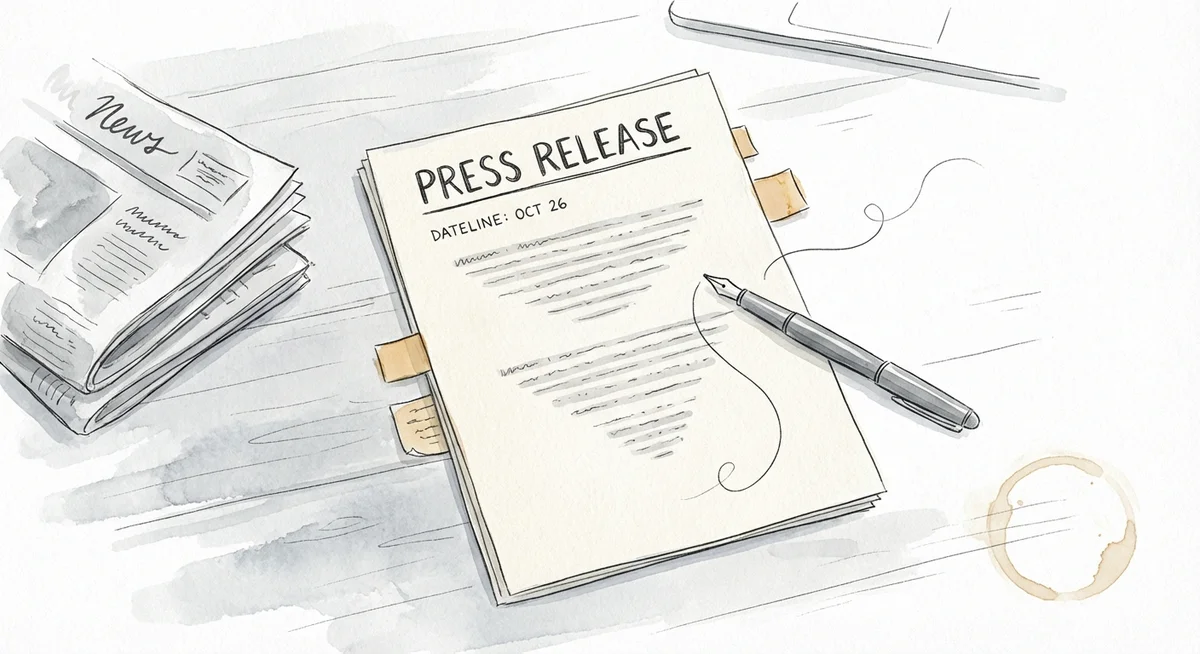
A well-crafted press release is still one of the most effective tools in communications. Social media, influencer marketing, and owned content haven't replaced it, because no other format does quite the same job: it presents your news in a structure journalists already know how to use. Get it right and you hand a reporter a half-written story. Get it wrong and your announcement vanishes into an inbox with hundreds of others.
This guide is a practical reference. Whether you're a startup founder writing your first release, an in-house comms professional refreshing your approach, or a business owner who wants to know what good PR output looks like before briefing an agency, keep it handy and use it every time you sit down to write.
What a Press Release Is (and When to Use One)
A press release is an official, news-style statement designed to inform journalists and stakeholders about something newsworthy. That could be a product launch, a senior appointment, a partnership, research findings, a funding round, or a company milestone.
It helps to distinguish the press release from two formats it often gets confused with:
Media pitch. A personalised email to a specific journalist, explaining why their audience would care about your story. Pitches are conversational; press releases are formal.
Media advisory. A short, factual notice alerting journalists to an upcoming event like a press conference or public demonstration. It tells them where to show up, not the full story.
Use a press release when you have genuine news. Something that has happened, is happening, or is about to happen. If you're trying to build a relationship with a journalist or suggest a feature idea, a pitch is the better tool.
The Standard Press Release Structure
Every press release follows a broadly consistent structure. Journalists expect it, and deviating creates friction.
- Headline. A clear, factual summary of the news.
- Dateline. The date and location (e.g., London, 15 July 2025).
- Lead paragraph. The essential news in roughly 50 words, answering the five Ws.
- Body paragraphs. Supporting details, context, and data in descending order of importance.
- Quotes. One or two attributed quotes that add perspective and a human voice.
- Boilerplate. A short paragraph about your organisation.
- Contact information. Name, phone number, and email for your press contact.
- Ends marker. The word "ENDS" or the symbol "###" to signal the release is complete.
This follows the inverted pyramid: the most newsworthy information sits at the top, with supporting detail tapering below. A journalist should be able to cut your release from the bottom up and still have a usable story.
Writing Compelling Headlines
Your headline is the most important line in the release. If it fails, nothing else matters. The journalist won't read past it.
A strong headline is factual and specific, written in active voice, under 70 characters where possible, and free of jargon. No "revolutionary," "ground-breaking," or "world-class."
Here's the difference:
Weak: Leading Innovative Fintech Company Announces Revolutionary New AI-Powered Solution for the Financial Services Industry
Strong: Bristol Fintech Startup Raises £4m to Expand Open Banking Platform
The weak version is vague and stuffed with adjectives. The strong version includes a location, a figure, a company type, and a clear action. A reporter scanning 200 emails can immediately tell whether it's relevant to their beat.
Crafting the Lead Paragraph
The lead (sometimes "lede" in journalism) answers the five Ws: Who, What, When, Where, and Why. You have roughly 50 words to convey the core news. Think of it as the paragraph that would survive if the story were reduced to a single brief.
Weak lead: We are delighted to announce that after months of hard work and dedication from our incredible team, we have launched an exciting new product that we believe will transform the way people think about personal finance.
Strong lead: London-based fintech firm Cobalt has launched a free budgeting app aimed at helping UK renters manage their finances. The app, available from today on iOS and Android, uses open banking data to provide real-time spending insights and savings recommendations.
The weak lead is self-congratulatory and tells us almost nothing. The strong lead tells us who (Cobalt), what (a free budgeting app), when (today), where (UK, iOS and Android), and why (to help renters manage finances). A journalist can work with that immediately.
The Inverted Pyramid in Practice
After your lead, the body should be ordered so that each paragraph is slightly less essential than the last.
A practical ordering:
- Lead. The core news.
- Second paragraph. Key supporting detail: how it works, who it affects, a relevant figure.
- Third paragraph. A quote from a senior figure providing context.
- Fourth paragraph. Background, market context, or data.
- Fifth paragraph. A second quote from a partner, customer, or industry figure.
- Final paragraph. Remaining details, availability dates, or links.
This respects journalists' time. Many will only read the first two or three paragraphs before deciding whether to pursue the story. Others may run your release nearly verbatim, trimming from the bottom to fit their word count.
Writing Effective Quotes
Quotes serve a specific purpose: they add a human voice where the rest of the text should stay factual and neutral. They're your chance to express ambition or interpretation in a way a news article can't.
The most common mistake is writing quotes that sound like they were drafted by a committee and approved by legal. If no one would actually say the words aloud, rewrite them.
Stiff: "We are thrilled to be at the forefront of innovation in this space and look forward to leveraging our synergies to deliver best-in-class solutions for our valued customers."
Quotable: "Renters are consistently overlooked by financial tools designed for homeowners. This app gives them something that's actually built around how they manage money."
Some guidelines:
- Stick to one or two quotes. More than that and the release becomes unwieldy.
- Attribute to a named individual with their title. Journalists need this for their copy.
- Use an executive quote for strategic context and, if relevant, a customer or partner quote for external credibility.
- Don't repeat information already in the body. Quotes should add perspective, not echo facts.
The Boilerplate
The boilerplate is a standardised paragraph about your organisation that sits at the end of every release. Think of it as your company bio for journalists.
Keep it to 50 to 100 words covering what your organisation does in plain language, when it was founded, where it's based, any relevant scale indicators (customers, employees, markets), and your website URL.
Write it once, review it quarterly, and resist the urge to cram in every award. The boilerplate is background, not a sales pitch.
Common Mistakes That Get Your Release Ignored
Certain mistakes come up with depressing regularity. Here are the ones that matter most:
Burying the news. If a journalist has to wade through four paragraphs of corporate context before finding out what happened, they'll move on. Lead with the news.
Going too long. A press release should rarely exceed one side of A4, roughly 400 to 600 words. If you can't convey the news concisely, you may not be clear on what the news actually is.
Buzzwords and superlatives. Words like "revolutionary," "disruptive," and "unique" actively undermine credibility. If your product is truly remarkable, the facts will show it.
No multimedia. Journalists increasingly expect images, video, or infographics. At minimum, include a link to downloadable high-resolution images or a press kit.
Poor formatting. Walls of text, inconsistent fonts, or releases sent as PDF attachments rather than pasted into the email body all create unnecessary friction.
Unverifiable claims. Industry bodies including the CIPR and PRCA have issued guidance on verifying experts and sources, particularly following concerns about AI-generated or fabricated personas. Make sure every person quoted is real, correctly titled, and available for follow-up.
Distribution: When, Who, and How
Writing a strong release is only half the work. Getting it in front of the right people at the right time matters just as much.
Timing
Journalists are most receptive to releases sent Tuesday to Wednesday mornings, ideally between 9:00 and 11:00 am. Avoid Friday afternoons, weekends, and the days around bank holidays unless your news is genuinely time-sensitive.
Targeting
Blanket distribution to every journalist you can find wastes everyone's time. Instead, identify journalists who cover your sector. Read their recent work to check your story fits their beat. Personalise your subject line and opening sentence where you can. This is where the press release meets the media pitch.
Follow-up
Wait 24 to 48 hours before following up. Keep it brief: one or two sentences asking whether they've had a chance to look. Accept silence gracefully; journalists get hundreds of pitches a week, and no response is itself a response. Don't chase by phone unless you have an existing relationship or the story is genuinely time-critical.
A Practical Press Release Template
Below is a framework you can adapt. Replace the bracketed sections with your details:
[HEADLINE: Active voice, under 70 characters, stating the core news]
[City, Date] — [Lead paragraph: 2–3 sentences answering who, what, when, where, and why. Approximately 50 words.]
[Second paragraph: Key supporting detail. How does this work? Who does it affect? Include a relevant figure or data point.]
[Quote from senior executive, attributed with full name and title.]
[Third or fourth paragraph: Additional context, background, or market relevance.]
[Optional second quote from a partner, customer, or external stakeholder.]
[Final paragraph: Remaining details, availability, pricing, links, or next steps.]
About [Organisation Name]
[Boilerplate: 50–100 words. What you do, when you were founded, where you're based, relevant scale indicators, website URL.]
Media Contact: [Full name] [Job title] [Phone number] [Email address]
ENDS
Measuring Effectiveness
Once your release is out, resist measuring success purely by volume of coverage. The industry has moved past outdated metrics like Advertising Value Equivalents (AVE). Instead, align your measurement with AMEC-standard frameworks that consider:
- Coverage quality. Are the right outlets covering the story? Is the tone accurate?
- Message penetration. Are your key messages being picked up and repeated?
- Stakeholder outcomes. Has coverage driven website traffic, enquiries, or other measurable actions?
- Long-term SEO value. Backlinks from authoritative media sites deliver compounding organic visibility over time.
Tracking these over time helps you refine your approach with each release and show tangible return on investment.
When to Bring in Professional Support
Writing a press release is a learnable skill. Distributing it effectively, building journalist relationships, understanding editorial calendars, and positioning your story within the broader news agenda: that's where experienced PR professionals earn their keep.
If you'd rather work with a specialist agency, pragencies.co.uk can help you find the right PR partner for your sector, budget, and objectives. Whether you need ongoing media relations or support with a single launch, the right agency can make the difference between a release that lands and one that goes unread.