The History of Public Relations
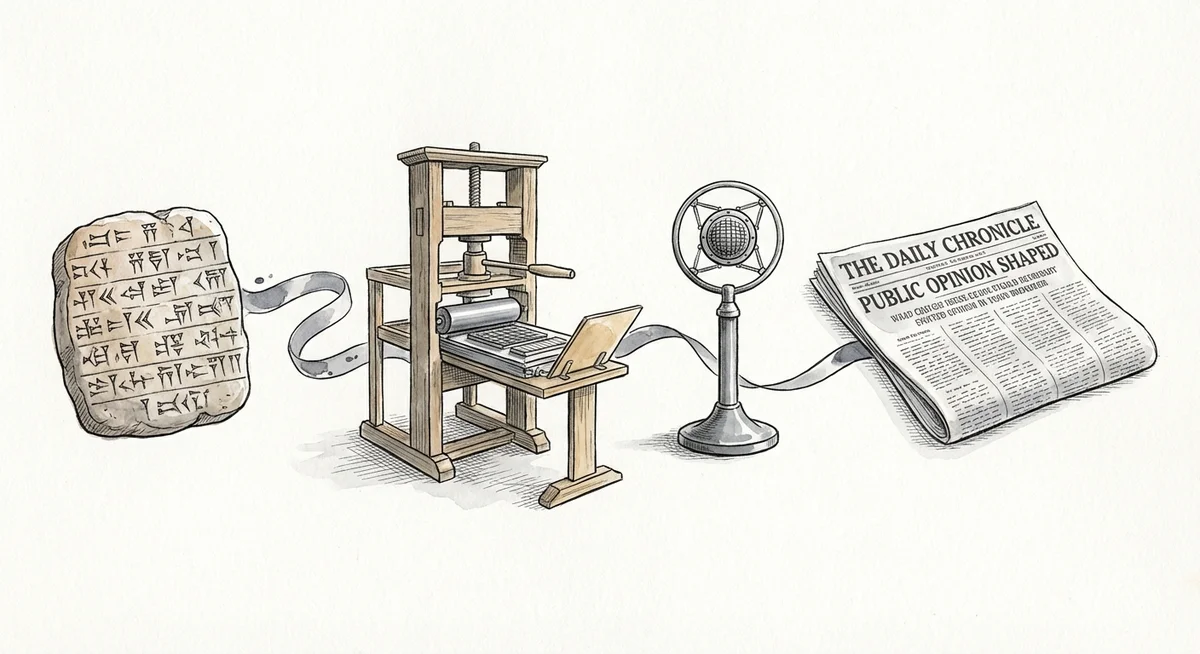
Public relations as a formal discipline may only be a little over a century old, but the art of shaping public perception and influencing opinion is as ancient as civilisation itself. From clay tablets in Mesopotamia to sophisticated digital campaigns, the fundamental human need to communicate, persuade, and build relationships has driven the evolution of what we now call PR.
Understanding this rich history offers valuable perspective for anyone working with a PR agency today. The strategies and principles that guide modern public relations didn't emerge in a vacuum—they were refined over millennia through political movements, corporate crises, and technological revolutions. Whether you're a startup seeking your first media coverage or an established organisation managing a complex reputation, knowing where PR comes from helps you appreciate where it's going.
Ancient Roots of Public Communication
Long before anyone coined the term "public relations," ancient civilisations understood the power of strategic communication. The earliest known example of organised public communication dates back to ancient Iraq, where a clay tablet promoting advanced agricultural techniques served as an early form of what we might now recognise as public information campaigning.
Egyptian pharaohs, Babylonian kings, and Persian emperors all employed communication strategies to establish and maintain their authority. The pyramids, obelisks, and monumental statues that still capture our imagination today weren't merely architectural achievements—they were deliberate statements designed to project power and assert divine right. These rulers understood that perception shapes reality, a principle that remains central to PR practice.
Classical Persuasion and Rhetoric
Ancient Greece contributed significantly to the philosophical foundations of public relations. The sophists taught rhetoric and the art of persuasion, skills that remain essential for any PR professional. Philosophers like Socrates engaged in public debate, demonstrating how reasoned argument could shift opinion and challenge established thinking.
In ancient China during the Han Dynasty (206 BC – 220 AD), handwritten news sheets called "tipao" were distributed among government officials—an early form of controlled information dissemination. Even biblical figures like Moses can be viewed through a PR lens, serving as spokespeople who communicated messages to the masses and shaped public understanding.
The Age of Print and Political Movements
The invention of the printing press revolutionised public communication, enabling ideas to spread faster and further than ever before. Martin Luther's use of pamphlets to disseminate his reformist ideas demonstrated the power of mass communication to challenge established institutions and rally public support.
In the lead-up to the American Revolution, Samuel Adams proved himself a master of propaganda, using newspapers, pamphlets, and organised events like the Boston Tea Party to build colonial unity and opposition to British rule. The abolitionist movements of the 18th and 19th centuries further refined these techniques, employing public lectures, books, and posters to shift moral opinion against slavery. These campaigns demonstrated that sustained, strategic communication could change deeply held social attitudes.
The Birth of Modern Public Relations
The Industrial Revolution created both the need and the opportunity for formalised public relations. As corporations grew larger and more powerful, they faced increasing scrutiny from the press, politicians, and the public. Managing these relationships became a business necessity.
The first corporate PR department is generally attributed to German industrial giant Krupp, established in 1870. In the United States, Westinghouse Electric Corporation followed suit in 1889. The term "public relations" itself first appeared in print in the 1897 Year Book of Railway Literature, reflecting the railroad industry's particular need to manage public perception during a period of rapid expansion and frequent controversy.
The Publicity Bureau and Early Agencies
The first dedicated PR agency, The Publicity Bureau, opened its doors in Boston in 1900. Its clients included major railroad companies and corporations seeking to influence public opinion and, crucially, to counter negative press coverage during an era of muckraking journalism. This marked a pivotal shift: public relations was becoming a professional service that organisations could engage externally.
The early agencies operated in an environment where corporate power was often viewed with suspicion. Investigative journalists exposed unsafe working conditions, monopolistic practices, and political corruption. Companies needed skilled communicators who could present their perspective effectively and, when warranted, demonstrate genuine reform.
Pioneers Who Shaped the Profession
Two figures stand out in the early professionalisation of public relations: Ivy Lee and Edward Bernays. Their contrasting approaches and lasting contributions established many of the principles and debates that continue to shape PR today.
Ivy Lee: The Father of Modern PR
Ivy Lee is often credited as the father of public relations, and for good reason. His 1906 "Declaration of Principles" established an ethical framework that distinguished professional PR from mere propaganda. Lee committed to providing accurate information, working in the public interest, and maintaining transparency with journalists.
Lee developed the modern press release, creating a standardised format for distributing news to media outlets. More fundamentally, he articulated what he called the "two-way-street" philosophy—the idea that organisations needed to listen to the public as well as communicate to them. This represented a significant departure from the one-way, top-down communication that had characterised earlier corporate messaging.
His most famous engagement was improving the public image of John D. Rockefeller, whose Standard Oil empire had made him one of the most vilified figures in America. Lee's strategy focused not on spin but on showcasing Rockefeller's philanthropy and humanising a man most Americans saw as a ruthless monopolist. The approach was controversial but effective, and it established a template for reputation rehabilitation that PR professionals still follow.
Edward Bernays: The Applied Social Scientist
If Ivy Lee was the practical pioneer, Edward Bernays was the theoretical architect of modern PR. A nephew of Sigmund Freud, Bernays drew on psychological insights to develop sophisticated techniques for shaping public opinion. He viewed public relations as an "applied social science" that could be studied, taught, and systematically improved.
Bernays wrote the first PR textbook, Crystallizing Public Opinion, in 1923, and taught the first college course on the subject at New York University. His campaigns were legendary for their creativity and psychological sophistication. To promote bacon sales, he surveyed physicians about the benefits of hearty breakfasts and then publicised their endorsements. To encourage women to smoke—a campaign that looks deeply problematic in hindsight—he framed cigarettes as "torches of freedom" associated with women's liberation.
Bernays' legacy is complex. His techniques were genuinely innovative and remain influential. Yet his willingness to manipulate public opinion for commercial ends, regardless of the underlying merit of the cause, raised ethical questions that the profession continues to grapple with.
World War I and the Power of Propaganda
The First World War demonstrated the power of organised public communication on an unprecedented scale. In the United States, the Committee on Public Information (CPI), also known as the Creel Commission, was established in 1917 to build public support for the war effort. Its techniques—posters, films, speakers, and carefully crafted messages—proved extraordinarily effective at shaping public opinion.
Many PR professionals gained their formative experience working for the CPI, including Edward Bernays himself. The war proved that mass communication could mobilise entire populations, a lesson that would be applied to commercial and political purposes in the decades that followed.
Professionalisation and Global Expansion
The mid-20th century saw public relations mature into a recognised profession with established practices, ethical standards, and educational pathways. Major agencies were founded during this period, including Edelman in 1952 and Burson-Marsteller in 1953, creating the infrastructure for a global industry.
Academic Recognition and Industry Development
Universities began offering PR courses and eventually full degree programmes. Trade associations formed to represent practitioners and establish professional standards. Specialised publications emerged to serve the growing community of PR professionals.
Arthur Page, who served as AT&T's Vice President of Public Relations from 1927, articulated principles that remain influential today. His famous dictum—"public relations is what you do, not what you say"—emphasised that effective PR must be grounded in genuine corporate behaviour, not merely clever messaging. An organisation that acts against the public interest will eventually find that no amount of communication can repair its reputation.
International Growth
Following World War II, PR practices spread globally as American corporations expanded overseas and established subsidiaries requiring local communication support. Agencies built international networks, adapting American techniques to different cultural contexts while learning from local practices.
This internationalisation brought new perspectives and challenges. What worked in New York didn't always translate to Tokyo or São Paulo. Cultural differences in media relations, attitudes toward corporate communication, and regulatory environments required PR professionals to develop more nuanced, locally informed approaches.
The Digital Revolution Transforms PR
The advent of the internet and subsequently social media fundamentally transformed how public relations operates. The changes have been so profound that the practice of PR today would be barely recognisable to Ivy Lee or Edward Bernays.
From One-Way Broadcast to Two-Way Conversation
The Cluetrain Manifesto of 1999 famously proclaimed that "markets are conversations." This insight proved prophetic for public relations. The internet, and particularly social media platforms, broke down the barriers between organisations and their audiences. Companies could no longer rely solely on intermediaries like journalists to reach the public; they could communicate directly—and the public could respond.
By 2006, the transformative impact of these technologies was widely accepted within the PR industry. Social media platforms became crucial tools for real-time communication, reputation monitoring, and crisis response. The press release evolved to incorporate multimedia elements, social sharing features, and search engine optimisation.
Specialisation and Sophistication
The complexity of the modern media landscape drove increasing specialisation within PR. The 1990s saw the emergence of dedicated practices in investor relations, technology PR, healthcare communications, and other sectors requiring specific expertise.
Data analytics became central to demonstrating PR effectiveness and return on investment. Where once PR success was measured largely through clip counting and advertising value equivalents, sophisticated measurement frameworks now track message penetration, sentiment shifts, share of voice, and business outcomes.
Crisis Communications: A Defining Discipline
Crisis communications has emerged as perhaps the most high-stakes and visible aspect of modern PR. How an organisation responds when things go wrong can determine its long-term reputation and even its survival.
The Johnson & Johnson Tylenol crisis of 1982 remains the benchmark for effective crisis response. When cyanide-laced capsules killed seven people in Chicago, the company faced a potentially existential threat. Johnson & Johnson's response—an immediate nationwide recall of 31 million bottles, transparent communication with the public, and the introduction of tamper-proof packaging—prioritised customer safety over short-term financial considerations.
The Tylenol case demonstrated that crisis response reveals corporate character. Johnson & Johnson's actions aligned with its stated values, and the public responded with trust. The company recovered its market share within a year, a testament to the reputational dividend that principled crisis management can deliver.
Public Relations Today and Tomorrow
Today, PR is an indispensable function for organisations of all sizes and sectors. The profession has evolved from its sometimes murky origins in propaganda and corporate self-interest toward a more strategic, evidence-based discipline that emphasises authentic communication and genuine relationship-building.
Modern public relations professionals must navigate an extraordinarily complex landscape. They work across traditional and digital media, manage stakeholder relationships ranging from journalists to activists to investors, prepare for crises that can emerge and escalate within hours, and demonstrate measurable value to organisations under constant pressure to justify expenditure.
The core principles established by pioneers like Ivy Lee and Arthur Page remain relevant: accuracy matters, actions must align with words, and effective PR serves not just organisational interests but the public interest as well. These principles, refined over more than a century of professional practice, provide the foundation for building the credibility, trust, and reputation that organisations need to thrive.
For businesses and individuals considering PR services, this history offers reassurance and guidance. The techniques that agencies employ today are not tricks or gimmicks but the refined practices of a mature profession with deep roots and a substantial body of knowledge. Understanding where PR comes from helps set realistic expectations for what it can achieve—and provides the context to recognise when you're working with practitioners who truly understand their craft.